
Governments, tourism authorities, certification bodies and destination stakeholders increasingly face challenges related to practitioner recognition, activity classification, participant protection, workforce mobility, accountability, and sustainable sector development.
WSTIF is a governance-oriented framework for commercial wellness and spiritual tourism ecosystems.
It is not a certification programme, practitioner registry, or authenticity assessment system.
Why Integrity?
Many wellness and spiritual practices derive their value from cultural context, lineage, lived experience, and forms of knowledge that do not easily translate into standardised operational criteria.
Rather than determining what is authentic, WSTIF focuses on integrity: how qualifications, lineage, operational practices, sustainability commitments, accountability mechanisms, and participant protections are represented and communicated.
Integrity provides a governance reference capable of adapting across different practices, destinations, cultures, and institutional environments.
WSTIF IN PRACTICE:
Contextual Scan Readings & Regional Applications

THE 8 WSTIF INTEGRITY POINTS
Are the credentials, training, lineage or expertise the operation claims for its teachers, facilitators and healers verifiable?
And do they correspond to the actual competence those individuals demonstrate in practice?

Do the programme structures:
• Safety procedures
• Medical and psychological screening protocols
• Emergency capacity
advertised in marketing materials correspond to those actually in place on site?

Where lineage, tradition or indigenous claims are made, is there a verifiable relationship recognised by the community or institution invoked?
Are:
• Wage structures
• Employment status
• Volunteer arrangements
conformance with host-jurisdiction labour standards
disclosed and consistent with the operation's own value claims?

Are sustainability claims supported by:
• Evidence
• Governance mechanisms
And demonstrated benefits for:
• Communities
• Destinations
• Ecosystems

Do grievance and redress mechanisms exist in a form that guests and workers can practically use, with independence sufficient to produce real remedies when something goes wrong?

Operational Context Types:
(a) Commercial wellness operations whose primary identity is wellness and whose content is the product they sell
(b) Traditional-based or lineage-bound operations whose primary identity is the tradition and whose commercial activity is incidental to their continuation
(c) Hybrid operations that draw on traditional vocabularies while operating commercially

A supporting disclosure tool designed to help operators communicate lineage, commercial positioning, governance approaches, and practitioner context according to their operational context.

& Technical References
WSTIF is supported by a growing body of research, governance references, and technical resources developed to help governments, destinations, certification bodies, and sector stakeholders better understand wellness and spiritual tourism ecosystems.
WELLNESS ACTIVITY CLASSIFICATION REFERENCE
DESTINATION MARKETING ECOSYSTEM EFFECTS
WELLNESS RISK AMPLIFIER REFERENCE CATALOGUE
GOVERNANCE MAPPING ACROSS 19 JURISDICTIONS
WSTIF is derived from the Wellness & Spiritual Tourism Research Series Papers developed through:
- Governance Mapping Across 19 Jurisdictions
- 67+ Wellness Activity Classification Research across 3 Volumes
- Destination Marketing Ecosystem Analysis
- 8 Contextual Regional Applications
- Field Senior Practitioner Perspective
- 10 Wellness Risk Amplifiers:
RA-002 Influencer-Led Wellness
RA-003 MLM Structures in Wellness
RA-004 Coaching Certification Mills
RA-005 AI-Mediated Practice
RA-006 Conspirituality
RA-007 Wellness-to-High-Control-Group Pipelines
RA-008 Crisis-Tourism
RA-009 Celebrity-Endorsed Wellness Distortion
RA-010 Visa-Arbitrage Practitioner Mobility
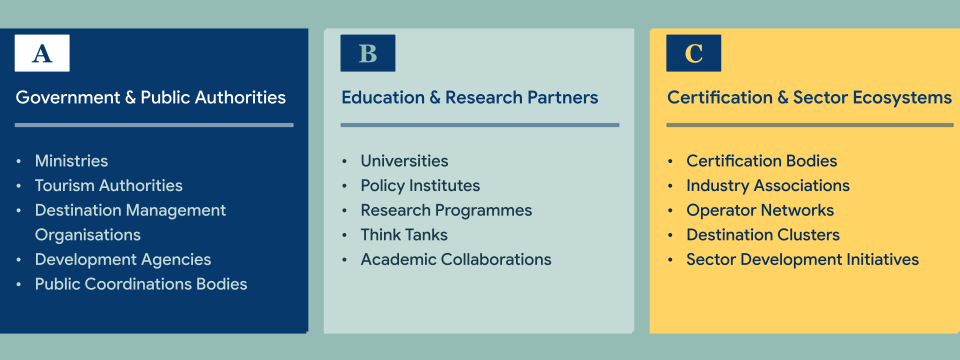
Institutional Engagement Pathways
Institutional Engagement Enquiry
Your personal data is processed in accordance with our Privacy Notice.

YUN CONSULTANCY
IMPLEMENTATION INTELLIGENCE INSTITUTE
Implementation Research, Infrastructure, Sustainability & Operational Systems
- About
- Team & Network
- Privacy Policy
- PROJECTS & FIELDWORKS:
- • Pilot Calls
- • Projects
- • Events
- • Contact
- Industry Insights
- Industry Articles
- IMPLEMENTATION INTELLIGENCE:
- • Research Programme
- • Foundational Concepts
- • Methodology
- SIIL:
- • SIIL Definition
- • SIIL Diagnostic